
Custom B2B Partner Portal

Business partners needed a dedicated digital environment for ordering, account access, documents and self-service, while the company needed those processes to remain connected to its existing business systems. We built a custom B2B portal around the company's processes, user roles and integrations, giving partners one place to access services and business information.

Custom B2B Partner Portal

Self-service for partners

Partners can access relevant services and information without relying on manual communication.

Connected business processes

Portal journeys can use information from ordering and enterprise systems.

One digital environment

Orders, accounts, documents and business services are available in one place.

From customer needs to portal architecture

Customer needs

Business customers and partners often need access to more than a product catalogue.

They may need to:

  • Place and manage orders
  • Access their customer account
  • View relevant business information
  • Access documents
  • Use self-service functions
  • Receive educational or product information
  • Interact with services connected to the company's internal systems

Without a dedicated portal, these processes can depend on email, phone communication, separate systems or manual work by internal teams.

The company needed a digital environment designed around its actual partner processes rather than a generic portal template.
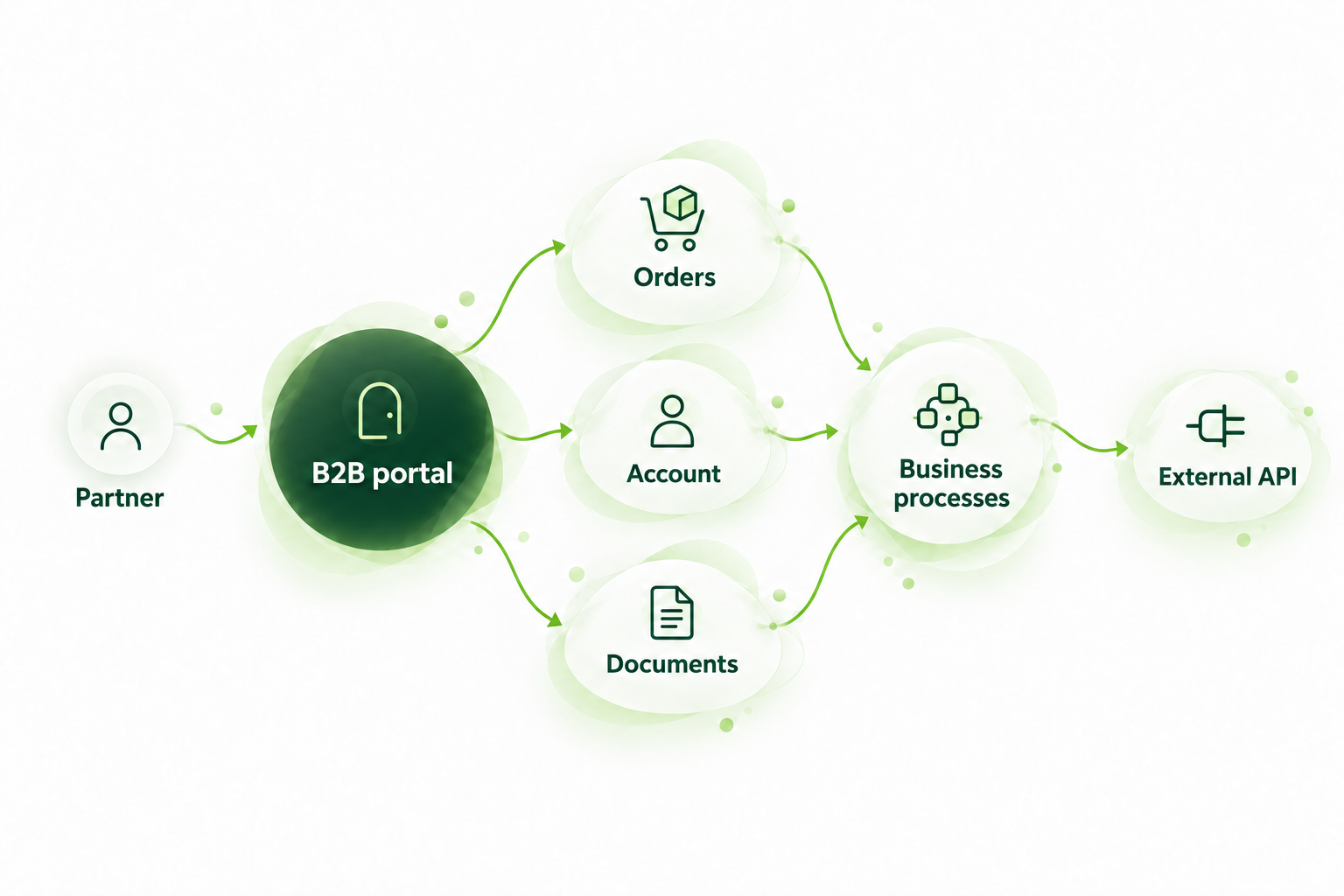
Portal architecture

We designed and developed a custom B2B partner portal around the required processes, user groups and connected business systems.

The portal acts as a digital self-service layer between partners and the company's existing systems.

The portal structure, functions, roles and integrations are defined according to the company's requirements and existing environment.

From customer needs to portal architecture

Key features

1

B2B partner area with dedicated access

2

Online ordering and B2B e-commerce

3

Customer account management and self-service

4

Document sharing in one environment

5

Role-based access for different partner groups

6

External API integrations with business systems

Result

Before

When a partner needed to place an order, check their account or obtain a document, they had to send an email, phone the company or use another separate system. Internal teams then handled a large share of these requests manually.

After

A partner logs in to a dedicated area to place and manage orders online, manage their account and find the documents they need. The available functions and content match their role, and the portal exchanges the required information with business systems such as CRM or SAP through APIs.

Key outcomes

  • Partners can handle orders and account-related processes online
  • Customer and partner information can be connected with existing systems
  • Documents and relevant information are available in one environment
  • Portal journeys can be tailored to different user groups
  • Business processes can use information from CRM, SAP and external systems
  • The portal creates a foundation for further digital services

Key takeaway

A B2B portal is most valuable when it is built around the actual processes of partners and the systems behind those processes. The portal becomes more than a website: it provides a self-service layer connecting customers and partners with ordering, accounts, documents and business systems.

Book a consultation

Frequently asked questions

Which partner tasks are available in the custom B2B portal?

In the portal, partners can place and manage orders online, access their customer account, view relevant business information and work with documents. Self-service functions, educational and product information, and services connected to the company's internal systems are also available. The exact scope of functions is defined according to the company's processes and its individual partner groups.

How does the portal connect partners with existing business systems?

The portal acts as a digital self-service layer between partners and the company's existing systems. It is connected through APIs to business systems such as CRM, SAP, ERP, accounting or production systems, so orders, account details and other information are not created in isolation. Which integrations the portal uses depends on the company's requirements and existing environment.

How are partner roles reflected in the portal design?

The portal was designed around user groups and their actual processes rather than a generic template. Access to functions and information is role-based, so different partner groups can follow different journeys through the portal and see the content that is relevant to them. Roles, portal structure and functions are all defined according to the company's requirements.

Why does the portal replace fragmented email and telephone processes?

Without a dedicated portal, orders, account queries and document requests depended on email, phone calls, separate systems or manual work by internal teams. The portal brings these tasks into one digital environment where partners complete them online themselves. Because it is connected to business systems, internal teams no longer have to process each of these requests manually.

Technologies

REST APIs CRM SAP ERP E-commerce platform Accounting-system integration Production-system integration